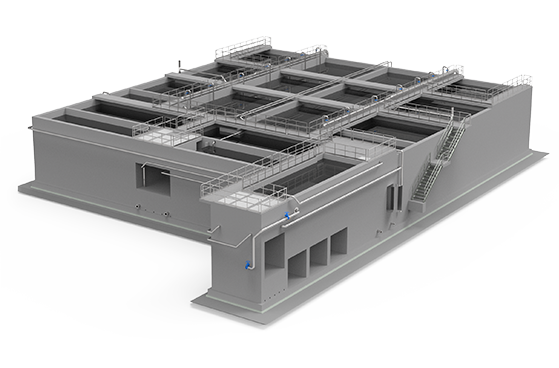

In cities, mainly in developing countries, where the construction of sewer networks is not feasible for financial or other reasons, but the generated wastewater must be treated to prevent environmental and public health problems, decentralised treatment technologies can provide a solution for the safe, affordable and sustainable treatment of 100% liquid waste (faecal sludge).
However, wastewater that is not conveyed through a sewer network requires the application of dedicated, specialised treatment technology.

Comparison of the characteristics of sewered wastewater and 100% faecal sludge
To address this design challenge, we developed a unique, proprietary technology that provides a safe and rapid solution for the proper treatment of 100% faecal sludge, even at the scale of entire municipalities.
Our proprietary and unique solution for treating untreated faecal sludge on a large-scale, the Septopure® technology, has been recognised by the United Nations as a technology contributing to accelerating the achievement of the Sustainable Development Goals (SDGs):
https://sdgs.un.org/partnerships/affordable-wastewater-treatment-technology-treat-100-liquid-waste-faecal-sludge-value, as it can reduce the overall environmental burden of cities without sewer networks in the short term. With this technology, we can design and construct treatment plants fully tailored to the specific site, local conditions and individual challenges, thereby enabling a rapid improvement in the living conditions of local communities.
With the application of Septopure®, wastewater can be treated on a large scale, with capacities of more than 1,000 m³ per day. Unlike nature-based solutions, which rely on natural processes and ecosystems to achieve a certain level of wastewater treatment, such as pond-based systems, Septopure® does not require the continuous allocation of additional land. The system is capable of treating highly concentrated and heavily polluted faecal sludge and is suitable for serving entire municipalities. A treatment plant with a capacity of approximately 1,000 m³ per day can contribute to healthier living conditions for as many as 2–3 million people.
Pureco has already successfully applied this technology in the design of several projects. Most recently, faecal sludge treatment plants were constructed according to our designs in three major cities in Ghana: Kumasi, Takoradi and Tamale. Together, these facilities have a total capacity corresponding to a population equivalent of more than 500,000 PE.