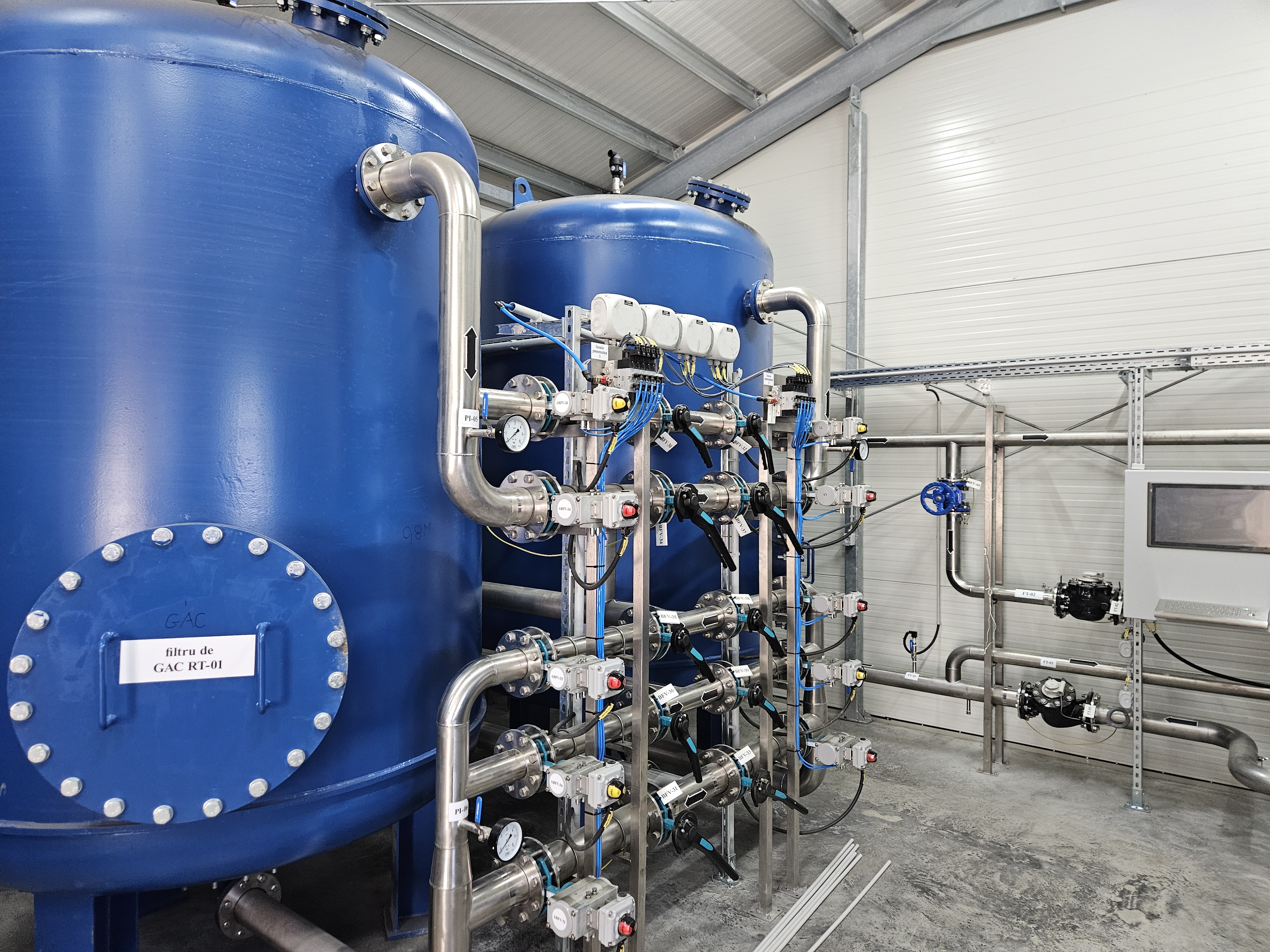

The raw water treated at the Alsókocsoba Water Treatment Plant in Romania is supplied by an existing deep well located on the plant site. Water contains arsenic and ammonium at concentrations exceeding the applicable limit values.
The plant has a nominal capacity of 792 m³. The design objective was to reduce the arsenic concentration from 28 µg/L to below 10 µg/L and the ammonium concentration from 2.29 mg/L to below 0.5 mg/L. Further requirements included maintaining stable water quality even under fluctuating loads, minimising chemical and energy consumption, and generating as little waste as possible.
Due to the specific characteristics of the raw water: namely the fluctuating arsenic concentration and the predominance of trivalent arsenic, As(III), conventional iron-based arsenic removal technologies were unable to deliver satisfactory results.
The solution was therefore based on a regenerable adsorbent-based technology, which ensures stable treated-water quality even when the quality of the raw water varies. One of the most important advantages of technology - developed and manufactured by Puraset Ltd., a member of the Pureco Group of Companies - is that it is eliminating the need for its regular replacement and disposal as hazardous waste. This significantly reduces both waste generation and operating costs while supporting a circular operating model.
The water treatment plant was constructed around the existing well and the existing 200 m³ storage tank, complemented by a new 300 m³ treated-water storage tank. The arrangement of the parallel tanks was determined by standard manufacturer sizes: the nominal capacity is provided by parallel-connected sand filters, activated carbon filters and arsenic removal tanks. The arsenic adsorber filters are made of corrosion-resistant PA-6 polyamide, while the plant’s other pressure tanks are made of epoxy-coated steel.
An important operational feature is that the adsorbent media is only backwashed at the water treatment plant. The regeneration process that restores its adsorption capacity is carried out off-site. As a result, no regeneration chemicals need to be stored or handled at the plant, and no arsenic-contaminated wastewater is generated on site.
Why is arsenic removal still relevant today?
Reducing arsenic concentrations in drinking water remains a significant water quality challenge in many regions. However, an effective solution involves more than simply complying with the applicable limit values: operational reliability, cost efficiency and long-term sustainability are equally important.
The regenerable adsorbent-based arsenic removal project implemented at the Cociuba Mare Water Treatment Plant in Bihor County, Romania, demonstrates how the right technological choice can do more than provide safe drinking water. It can also reduce waste generation, support circular operation and offer a more favourable solution in terms of life-cycle costs.
The project also confirms an important engineering principle: the most advantageous solution should be selected based not on the initial investment cost alone, but on the total cost over the system’s entire life cycle.